
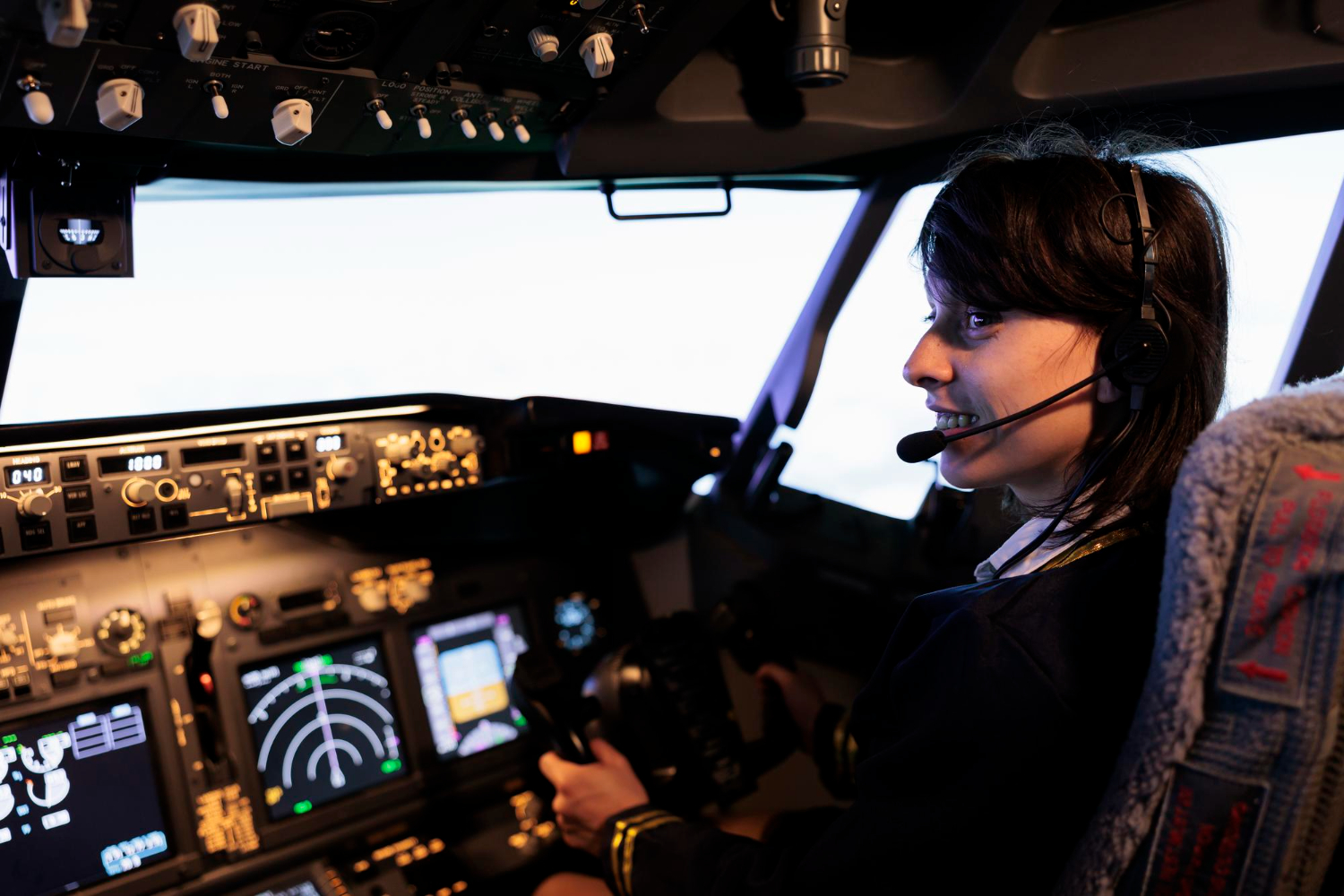
If you are reading this, you have probably already decided that you want to fly. What you may not know yet is where to start, how much it costs, how long it takes, or what “integrated ATPL” actually means. This article answers those questions with real data and a concrete roadmap for anyone who wants to become a commercial pilot in Spain with no prior experience.
We also address the gender context, because the numbers exist and it is better to know them — not as a barrier, but as useful information for anyone making this decision.
What Licences Do You Need to Become a Commercial Pilot in Spain?
In Spain, pilot training and licensing is governed by the European EASA Part-FCL regulation, managed nationally by AESA (the Spanish Aviation Safety Agency). Licences obtained in Spain are valid across the European Union and carry international recognition.
PPL – Private Pilot Licence
The PPL is the first licence you obtain. It allows you to fly single-engine aircraft and carry passengers, but without remuneration. It is the entry point into aviation and the foundation on which everything else is built. At EAS Barcelona, the PPL course is available as a first step towards a professional career.
ATPL – Airline Transport Pilot Licence
The ATPL is the highest pilot licence and allows the holder to act as a commander on commercial airlines. In practice, new pilots entering the job market obtain a frozen ATPL: they have passed all ATPL theory exams and hold an active CPL, and the ATPL is officially unfrozen once they reach the required 1,500 flight hours. With a frozen ATPL, pilots can work as first officers (co-pilots) from day one.
Minimum Requirements to Start Training in Spain
EASA regulations do not require any university degree. The actual requirements to start are:
- Minimum age: 17 years to begin PPL training; 18 years for the integrated ATPL at most schools.
- Minimum height: 1.57 m (5’2″).
- EASA Class 1 Medical Certificate, issued by an AESA-authorised centre. It is strongly recommended to obtain this before investing in training. Glasses are permitted within certain limits.
- English proficiency: minimum ICAO Level 4 (spoken and written). No external certificate (IELTS, Cambridge) is required.
- Secondary school level in maths and physics. An engineering degree is not required.
Important: regulations make no distinction based on gender. Training requirements, theory exams, and flight hours are exactly the same for men and women.
Step-by-Step: How to Become a Commercial Pilot
The most direct path to an airline in Spain runs through the integrated ATPL — a full-time programme of 18 to 24 months. Here are the steps:
Step 1: Obtain Your Class 1 Medical Certificate
Before enrolling, you must pass the EASA Class 1 aviation medical examination at an AESA-authorised centre. It assesses vision, hearing, cardiovascular health, mental fitness and other parameters. This is the first filter to clear.
Step 2: Choose Your School and Programme
Spain offers two main routes: the integrated ATPL (18-24 months, full-time, from zero to CPL + frozen ATPL + MEIR) and the modular programme (more flexible, starting from the PPL). EAS Barcelona offers both from Sabadell Aerodrome (LELL), with excellent flying weather throughout the year.
Step 3: ATPL Theory (14 Subjects)
The ATPL theory programme covers 14 subjects including meteorology, navigation, aircraft performance, systems and air law, among others. EASA regulations require a minimum of 650 hours of theoretical study. Official exams are administered by AESA.
Step 4: Practical Flight Training
The flight training roadmap includes VFR (Visual Flight Rules), IFR (Instrument Flight Rules), multi-engine flying and UPRT (Upset Prevention and Recovery Training). Upon completion, students must log a minimum of 195 flight hours under the integrated programme.
Step 5: CPL with Frozen ATPL and MEIR
After passing all theory exams, skill tests and meeting the flight hour requirements, AESA issues the CPL(A) with frozen ATPL and MEIR rating. This is the licence with which most new pilots enter the job market.
Step 6: MCC/JOC and Type Rating
Most airlines require the MCC/JOC course (Multi-Crew Cooperation / Jet Orientation Course) and a type rating for the aircraft to be operated — Airbus A320 and Boeing 737 are the most common. The cost of a type rating is approximately €18,000.
Step 7: Full ATPL Activation
Once 1,500 flight hours are logged as a first officer, the pilot can apply to AESA for the full ATPL, which authorises the holder to act as aircraft commander.
Women in Commercial Aviation: The Current Data
Globally, only 5.1% of pilots are women, according to data from the IATA 25by25 initiative published in 2024 (source: informeaereo.com). In Spain, SEPLA (the Spanish Airline Pilots Union) data puts the figure at around 4%, with approximately 258 female aviators out of more than 6,000 affiliated pilots.
The trend is positive. According to a CAPA report published in August 2024, the number of female airline pilots in the United States grew by 11% in 2023, compared to 4% for all pilots. In the United Kingdom, the Civil Aviation Authority recorded a 26% increase in pilot licences issued to women between 2019 and 2023 — more than double the overall sector growth.
Under-representation reflects historical and cultural barriers, not aptitude. The cockpit does not distinguish between genders: what sets pilots apart is their training, their judgement and their flight hours.
How Much Does Pilot Training Cost in Spain?
- Integrated or modular ATPL (CPL + frozen ATPL + MEIR): average cost of €70,000.
- Programmes including a university degree: can exceed €120,000.
- A320 or B737 type rating: approximately €18,000 additional.
Specialised banking finance options and airline cadet programmes from some European carriers are available. It is advisable to research these before choosing a school.
Why Train at EAS Barcelona?
EAS Barcelona is an aviation training school based at Sabadell Aerodrome (LELL), just a few kilometres from Barcelona. It offers the PPL course and the integrated ATPL programme under EASA regulations, with certified instructors and its own fleet. The Mediterranean climate guarantees a high number of VFR days per year, ensuring consistent training progress with minimal weather-related interruptions.
The first step is always the same: obtain your Class 1 medical certificate before anything else. Everything else can be planned once you have cleared that initial requirement.
Frequently Asked Questions
What are the minimum requirements to become a pilot in Spain?
Minimum age of 17 (18 for integrated ATPL at most schools), minimum height of 1.57 m, and a Class 1 Medical Certificate. No university degree required. ICAO Level 4 English and secondary-level maths and physics are recommended.
What is the difference between a PPL and an ATPL?
The PPL is the private pilot licence (no remuneration). The ATPL is the highest licence, required to act as airline commander. The integrated ATPL takes students from zero to CPL with frozen ATPL in 18-24 months.
How much does pilot training cost in Spain?
The integrated or modular ATPL averages €70,000. With a university degree it can exceed €120,000. The type rating adds approximately €18,000.
Do women face different requirements than men?
No. EASA/AESA regulations make no gender distinction. Medical, experience and examination requirements are identical for men and women.
What percentage of commercial pilots in Spain are women?
Around 4%, according to SEPLA. Globally, 5.1% according to the IATA 25by25 initiative (2024 data). The trend is upward.
What is an integrated ATPL and how does it differ from modular training?
The integrated programme is an intensive full-time course (18-24 months) from zero to CPL with frozen ATPL. The modular route is more flexible: it begins with the PPL and progresses through modules. Integrated is faster; modular is more adaptable.
Can I train to become a pilot in Barcelona?
Yes. EAS Barcelona operates from Sabadell Aerodrome and offers both the PPL and the integrated ATPL under EASA regulations, with certified instructors and its own fleet.